


Photos by Aricka Moultry-Davis.
Lora Faye Ashuvud, also known as Arthur Moon, seems convinced of her own strangeness. Upon first glance, it’s not entirely obvious. Her apartment is warm and timelessly decorated, smelling of sage which Lora says she lit to cover up the sent of Thai food. Her girlfriend has just baked pumpkin cookies which taste incredible. It’s all very homey and inviting. Idyllic even. But regardless of if Lora’s strangeness is apparently obvious or not, it is certainly there. It’s in the way that she takes long pauses to ponder her answers during our conversation, seeming to get lost in the maze of her own head. It’s in her description of a dream she had the night before of spiders crawling in military lines up and down her apartment. She doesn’t read notated music, but she has an innate understanding of melody that transforms her music into something ethereal and otherworldly even as if touches upon subjects that are politically relevant and humane. She isn’t naturally talented in science or math, but she and her producer and friend Marty take a break in between questions to demonstrate the standing wave concept by standing up and clapping a few times until a sound can be heard.
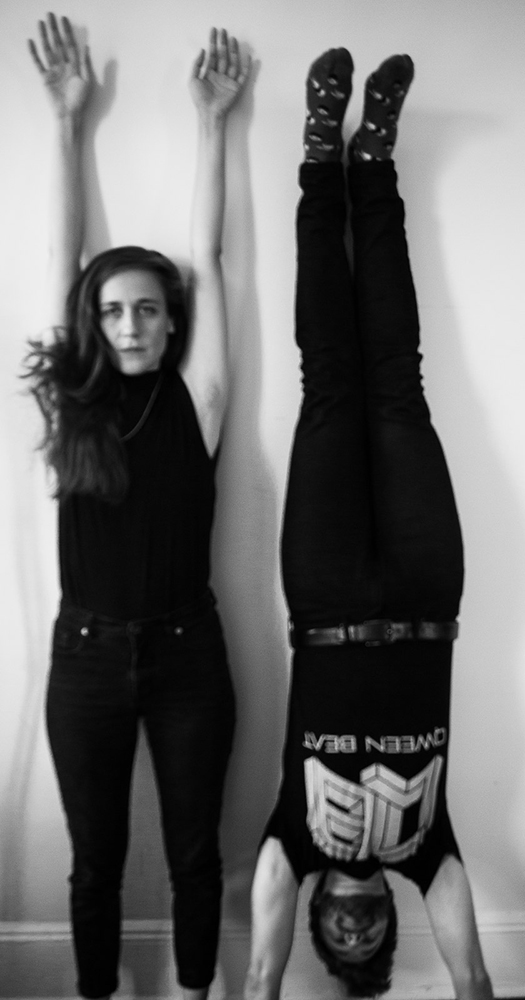
Lora is almost pathologically modest about her own clear intelligence and prowess and that is probably how she came to care as deeply as she does about the expression of queerness through her art. She talks about wanting queerness to go beyond even feminist or LGBT issues, to become an overarching narrative of simply not quite fitting in.
Maybe there was a time when Lora didn’t fit in, but she seems to have surrounded herself with people who are just as quirky and warm as she is. That warmth permeates our entire conversation, inviting those around her to listen, to join. To be as unapologetically opinionated as she is herself.
It works. I felt at home there.
New York Fashion Week just ended and I couldn’t help but remember last year when Dior released its line of “Everyone Should Be A Feminist” shirts and since then, I feel like I see that line emblazoned on everything. Your video “Wait A Minute” spoke of feminism in relation to consumerism. Do you think that is a problem? Do you think it could also be useful in some ways?
I will preface this by saying I am not a feminist scholar, I am a musician. I do have thoughts on the subject which is why I am making art about it but I am sure there are people who would be more eloquent on the subject like Roxanne Gay would probably have a tweet that would encapsulate this answer better than anything I could say.
I think it has both positive and negative things about it. A lot of the way that our culture metabolizes new ideas is through consumerism because of capitalism and metabolizing those ideas is better than not. But a lot of the more important messaging gets lost when it’s simplified into a t-shirt. It’s hard to point to intersectionality with a t-shirt that has the word feminist on it. Hopefully, those t-shirts are prompting more nuanced conversations about this stuff.
You often talk about your inability to read notated music. Is that something you would ever want to learn or do you think it might negatively affect your sound in some way if you began learned how to do this thing that you are “Supposed” to do as a musician?
We talk about this a lot. What the balance is between having an idea in your mind and then trying to execute it simply and efficiently. There are a lot of musicians like Marty (Arthur Moon’s producer) for example who can have an idea and just manifest it because they have these skills that come with reading music and understanding the rules around western music theory. And I think that is true and sometimes I am envious of the fact that folks in the band have that. I think it is a helpful balance for me when I come to them with some crazy shit that doesn’t really follow the rules and then follow the rules and think what about this is working even though it is technically incorrect and what about this could use a little bit of shaping or a little bit of simplification.
Everyone in my band is a weirdo too and we all have a way of breaking the rules that I really love. I understand basic music theory! But there does need to be a balance.
Marty: It’s also about communication. We can all be in a room and you and Kayla and Aviva will be singing harmonies and Kayla might say, “you take the 9 on this chord” and you will just be like, I’m going to sing this note here and you will know it’s what they are talking about even if you’re saying it a different way. We all like being in the room with Lora because she has such deep musicianship and then she also is coming from outside of the box with these ideas we may not be able to access since we are starting from being in a place where we are already in the box, and then it’s just a matter of all getting on the same page.
In fact, it is odd that there are so many rules when it comes to what it means to be a musician. Your music purposefully breaks those rules. Was there ever a time when you felt self-conscious of being “incorrect” as you have been called in the past?
I think a part of pinpointing it and talking about it publicly is a conscious effort on my part to overcome that anxiety which is also sort of imposter syndrome. Do I still count as a musician if I don’t check off those boxes? I know I do but calling it incorrect music is part of a process of coming to terms and embracing this as something that I don’t have to be ashamed of.

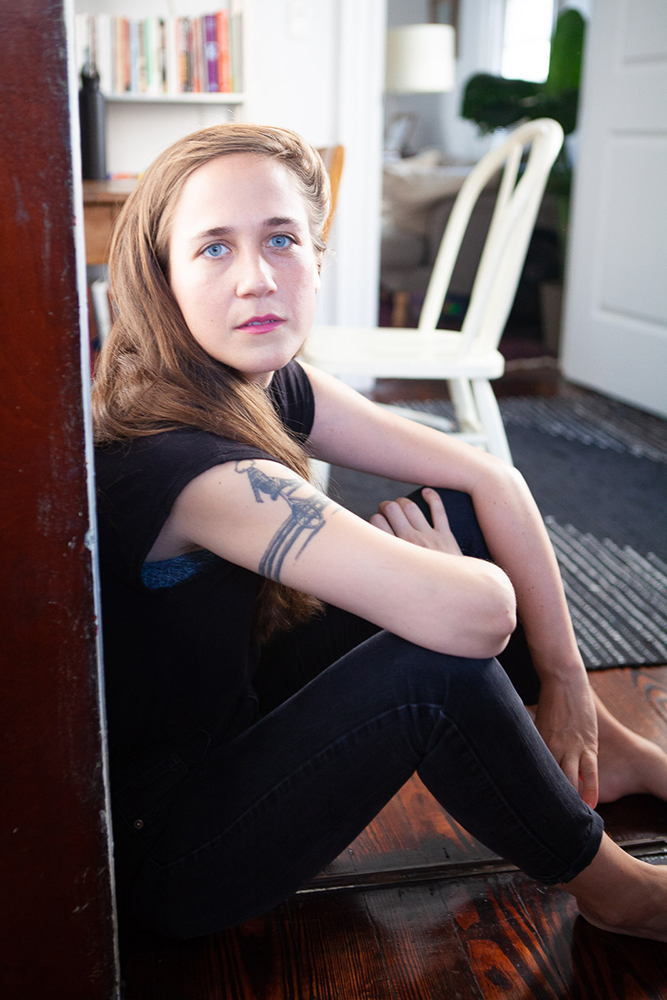
I love that you cited the “Old Dyke” movements of the past in your “Wait A Minute” single, do you see a sort of “New Dyke” movement being created in the present day? What do you see happening that makes you hopeful for the current Queer movement?
I feel excited about the fact that I can make music that is explicitly queer and have the queerness be not just that I am a lesbian but also that I have a perspective that is artistically and culturally valuable and I hope that it is a part of the new dyke movement as a broader understanding of what queerness is outside of the smaller communities and conversations around activism. Queerness is something that is not just necessarily about gay marriage.
I googled Arthur Moon, and I actually stumbled upon an Australian army Doctor named Arthur Moon, coincidence?
So, the story behind my name is that Marcel Duchamp’s alter ego came to me in a dream. Her name was Rrose Selavie which in French was a play on C’est La Vie. She came to me in a dream and told me I was Arthur Moon.
Reading about the way you use cut up news articles to write (or inspire your writing) reminds me of the way that William Shakespeare’s would purchase previously written stories and use them to make something transcendent in his own writing. Do you read through these articles and assemble the lyrics from pieces that stand out to you or is it more random and by chance?
The best ones come from travel magazines so it’s not like heavy intellectual stuff. There is a lot of really great, bizarre language in those. Sometimes I’ll read through as I look at it. And sometimes I’ll keep a poem to words from one article, others I’ll just move things around and scatter the words around. They’re usually not directly correlating to any specific article. Although the first song that we did that with was the song “Room” which we put out a few years ago which was originally called IKEA song because we did it with a page of ads in an IKEA catalog. Usually, it’s a bit more abstract.
I read what you said about the standing wave concept in physics and I remembered that often times, mathematical prowess can translate into musical talent. It’s interesting that you would be interested in physics since much of science and math is about a strict set of rules and you are all about breaking the rules. How do you make sense of these interests within yourself?
I’m terrible at science and math but I think I can sometimes access the broader ideas. I don’t think it comes from any inmate mathematical genius. I didn’t take any of that throughout my entire college career.
I feel like you come off as very hopeful for our revolution and New York City’s insistence on equality and acceptance. Would you say we are going through a new sexual revolution now? A lot of the music we are seeing reminds me of the anthems popping up around the 60s and 70s.
There is so much more space for conversations about social justice in mainstream music these days in a way that I can see how it would relate to the 60s and 70s. My feeling is that at it’s best right now it’s more interesting than it was. Talking about social justice in mainstream music, a lot of these folks are adjusting to the ways that women’s issues intersect with race and sexuality which I don’t think was as understood back then.
What got you reading and researching about standing waves in the first place? Do you think these theories pop up when they are most needed?
That idea is something musicians talk a lot about. Marty can describe this better than I can but I just love how disorienting it is to experience it. Guitars work through some standing waves. We should probably talk to someone who actually studies this…
To answer your question better, yes these ideas do come when you need them. That’s what I love about art is that part when the idea really comes to you. That’s why I try to write without approaching it from a set of rules. I like to see what happens. Sometimes it’s crap and sometimes it feels like I’m a lightning rod and great ideas come and you look at what you’ve created and it feels like it wasn’t even you, it was some outside force. Those are the best ones.
You can find Arthur Moon on Facebook, Twitter, and Instagram.