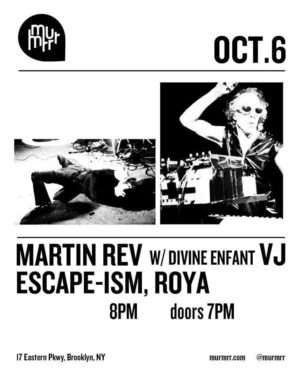

It’s always interesting to experience an artist who is somehow a chameleon, yet very individual and recognizable. Ian Svenonius has been making music since 1990 through different bands and in varying genres. Escape-ism, though, is Svenonius as a solo artist.
Last year Svenonius brought the group into the world with Introduction to Escape-ism a futuristic, howling, robotic (but still haunting) reflection of himself. Escape-ism is just him accompanied by a drum machine, backing tracks, guitar and his powerful and transformative persona (whether it be in front of audiences, through speakers or headphones, or wherever you might be listening).
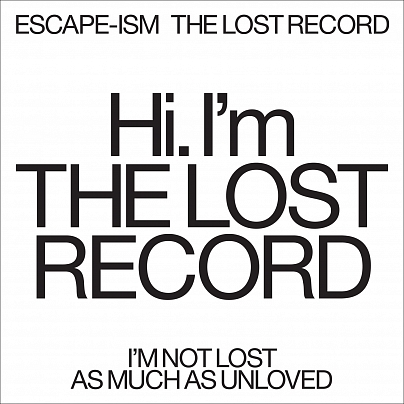
The Lost Record waves its presence to the listener first through the cover. In a plain black font we are greeted by, “Hi. I’m THE LOST RECORD. I’M NOT LOST AS MUCH AS UNLOVED.” Is this a formal reverence from the disc or a warning from its creator? Is it saying “listen to me because I have been forgotten and shelved” or “I sort of recorded a bunch of tracks, but I wasn’t in a hurry and kind of forgot about this album?” I suppose it doesn’t matter because The Lost Record is a movement in sound—a record that feels liberated and free among a rampant world of garage rock leftovers. I don’t think a lot of people know about its existence but those who do, will like it. Play it on repeat and smile and dance through it like tomorrow isn’t an option. It’s minimal yet victoriously chews your hips into its proto-static sound and festive insurgency.
Luckily before we all feel bad for the loneliness of this album, its first track explains everything. The Lost Record starts with an intro. The first clue into a scavenger hunt. A spoken map of where it can be found – not because it is lost, but rather unloved. To find this record you must like it, be interested, and be moved by it. You have to question things that are simple and banal. Is Svenonius serious about the album being kicked to the gutter by a label or is it all part of a bigger simpler concept? An act, a charade, a way to pull you in.
Better to listen to something lost than unloved. Why do I have to feel sorry and empathize with it? Is loving the unlovable part of the trick? Is this how I become human? Let your inner white knight syndrome kick in. Save this album!
And then it becomes “Nothing Personal,” a sort of a half assed apology—a way for the record to show that it’s unloved but strong and independent, with a mind of its own. A threat to expected behavior. The motor driven single has a note that loops throughout the whole song and sets the mood. You can still move your hips and neck to it. When guitars come in and a female backing vocal joins, the track submissively ends in a noisy atmosphere.
As a performer there are many easy to connect with an audience. “I’m a Lover” should be a mantra to anyone wanting to perform in front of others. There’s value in connection, and you need a full room to make an impact, you don’t need a vast audience to fulfill expression. Touching or hitting the right spot, just like a lover, is the key. From far away you are a blurry dot on a stage–from up close and personal you become human, and you dance, and you sing, and you shake it for the world to see–without a care in the world, because you are open to be loved, or hated, or judged. Having a front person mixing within in a crowd, in peoples faces becomes that night that you tell people about. An unforgettable memory and that is always Escape-ism.
I mean but after a performance like that who are you going to trust? Some people will do whatever to be heard, which can be good or it can be bad—like Svenonius in “(I’m Gonna) Bite the Hand That Feeds.” Watch out for him because he’s coming for you and he knows he’s ungrateful, but he doesn’t like the world, so who cares. You’ve been warned. Now there’s a clap section in the verse that serves more as a distraction to this warning.
There’s something about the intro of “Body Snatcher” that prompted me to think it was going to be this long-spoken word track that would later melt into song—but who has time for that? Instead it’s noise guitars and a single note that playfully glimmers through the whole track. The singer wants to be snatched every night and day, taken away. He is close to this snatcher of bodies and is surprised by this alien’s abilities and urges it to snatch him at all costs and leave nothing of him. Does it make you wonder if you can do anything to save him? Not really. He just wants another baby. He wants another love. He wants to be snatched by passion. To be seduced every day. Lust is often an out of body experience.
Then you arrive at “The Feeling’s Mutual,” a track about being disappointed with someone or something—and fuck, I thought we were the same and on the same page, but I guess we’re not. And the feeling is well, mutual.
In “I Don’t Know Where Those Words Have Been” Ian calls for affection, but he doesn’t know where this person’s hands, lips, ears, eyes, have been but now this person wants him to sing. I guess that’s some sort of commitment. I’ll be the best of me I can be. Adults playing the game of love within a playful cloud of synths and noise and a lazy drum beat.
“Exorcist Stairs” is all guitars and fun and perverse games that leads to none other than… The Exorcist! Yes, the movie. Ian talks about a place his “baby” should go to, and it will be fun, and you’ll get scared and scream but don’t worry–really horrible things don’t happen in real life. I really do not want to see anyone’s neck doing whatever. Ok, Ian… the stairs don’t sound fun, haha. Don’t take me there, man. I mean at least the relationship is equal (if theoretically we think he’s referring all this time to the same person) and he can count on this person to darken the night. Macabre, dark penning by Svenonius. “You Darken My Night” brings either the comfort of knowing someone is there for you and make things alright, or a good night sleep.
“Alphabet’s Gotta Be Changed” is repetitive and lacks the defiant turns Svenonius had been embracing with the rest of the tracks. There’s no sudden synth manipulation or washed-fuzz guitar lo-fi warp before almost every chorus but instead it reminds me of bands like Big Black where the instrumentation and the back bone of the allusion of a drummer in the song is limited, mechanized and patterned. “Rome Wasn’t Burned in a Day” blurs the musical lines with a bass line, that’s followed by a subtle snare and hi hat combo, and then a roaring guitar that break into an almost dissonant guitar solo that contrasts from the precision of the drum machine and bass that are carrying the song, basically.
For the final song of the album “What Sign (Was Frankenstein)” Ian screams and questions Frankenstein’s zodiac sign, the day of his birth. The melody dances around the fuzz-guitar, and an organ that injects new energy into the melody.
Svenonius personifies rock and roll’s truest form with this latest record from Escape-ism. The Lost Record is fun, unpredictable, simple, a radical and required punctuation for modern rock and roll. It feels as a moment of ultimate freedom, not perfect, but platonic—it feels good to get lost sometimes.