
Photo by Juan Blanco Garcia
Gustaf’s new single “The Motions” has a wonderfully chaotic hook. The song is a representation of the inner monologue that often breaks through our subconscious when we’re just walking around pretending to be normal people. Yes I say pretending because I don’t believe anyone’s inner thoughts are ever completely normal. I thought briefly about sharing an example of my own inner thoughts, but I would prefer not to go to jail.
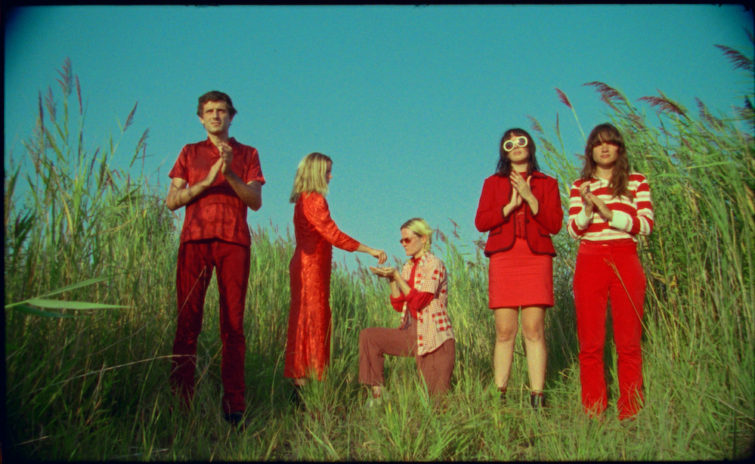
In the video, floaty 1960’s styled men and women pummel a fellow band member to the ground in the middle of a calm, green field. The camera shakes and the music speeds up, only to be broken up by the slow moving monologue of “watch, breathe, think, see”. Mirroring the voice in our heads that often tells us to calm down when we are about to publicly lose our cool. It’s a fun song that becomes truly enjoyable when the hook reveals the chaos underscoring that monologue. Personally, I rarely tell my inner voice to shut up. Maybe that’s why I found myself cheering whenever the monologue ended and we were able to lose ourselves in the energy and excitement of that fabulous hook.
Of the single, vocalist Lydia Gammill shared, “I always envisioned “The Motions” as our ‘walking around New York City’ song. The cadence is great for trudging across a bridge or taking the subway.
The song is about snapping between the perspective of your chaotic inner narrative while following the precut path of the world around you. Like when you’re strutting down the sidewalk to a song and your headphones slip off for a second to reveal the natural soundscape you’d been ignoring, realizing the world you had been wrapped up in is not the one shared by everyone else. Then you see that everyone with headphones is jumping between their own personal world and the reality they’re actually living in. I’ve found that if you walk around New York City without headphones, the streets are surprisingly silent. It’s us that add the cacophony of our own personal soundtracks.
The song shuffles through these different perspectives. The hook (watch, breathe, think, see…) mimics the grounding voice inside the narrator’s head going through their next steps while interiorly they’re barely keeping it together. The first (and only) verse is their inner monologue breaking through as they participate in the slog of getting from one place to another. They’re battling the imprint of another person, blaming them for getting in the way of their progress, their forward motions obstructed by the taunts and memory of someone else. Sort of like a hypothetical fight you have in the shower. Just as the inner mind derails into chaos, the second refrain snaps out to the 3rd person and we are back in the world’s choreography of the mundane. The performance of the habitual, human ants dancing along our track.
When you’re losing control of your inner narrative, the motions are the reminder you tell yourself to keep it together. Sometimes though you just can’t help it and get lost in the personal panic of the na-na-need feed of it all.”