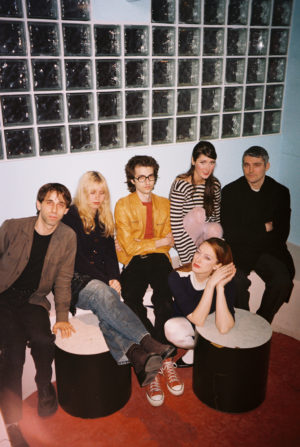



The week of CMJ is crazy — not just for us fans, struggling with earplugs and lack of sleep night after night. Those who have it obviously rougher are the members of the bands we are there to see. One of those band’s is NYC’s own Rocket & The Ghost. The quintet creates songs that sound just at home with classic rock n’ roll, while capturing enough of today’s energy to make them timeless. When I met with Rocket & The Ghost, they were refreshingly game and exuberant to chat with me, despite being halfway through CMJ. Read our talk about comfort zones, the struggles and triumphs of CMJ, and frontman Kiyoshi Matsuyama’s apparent love for daiquiris below.
I read somewhere that you want to take people out of their comfort zone when —
Kiyoshi Matsuyama: Yeah, always!
Brian Kesley: Let me stop you right there, Alex, that’s a great way to start this interview.
[laughter]What does that really mean in terms of the music or being on stage?
Kiyoshi: We are from New York, we play in New York City. I think that we’re thinking about things a little differently when we see bands in a city that’s this congested with talent. People have an expectation or it doesn’t move people in a lot of ways. What we try to do is break this glass wall that’s between the band and the audience. We all go to shows and we’re all just like, “Yeah this is nice.” But it’s important to just take everybody out of the box and remind them that they’re here to see a show.
And not just stand there?
Brian: Right. Especially in New York above most other cities I’ve ever played in. In New York people will go to a show just as a social event. Because it’s so inundated with so many shows and talent, [people] don’t really put a lot of priority on the event that they’re at. People will just catch up with a friend, grab some drinks, there’s a band playing. You might even pay ten to fifteen bucks to get in!
Kiyoshi: Music in a lot of ways is very background. I mean, every single place you go to: every deli, every grocery store, every bar, every rooftop. There’s music everywhere and it’s exhausting! Your ears can’t handle that much. So when you go see a band you’re desensitized to everything. What we’re trying to do is, we try to make people uncomfortable — but not quite in the way that that sounds. We try to bring them into what we’re actually doing and the live show is actually special.
How have you been crafting this around CMJ?
Kiyoshi: Well [during] CMJ it’s even harder. Not only are you desensitized on the whole but now you’re seeing every band and saying,”What do you have?” Know what I mean?
Yeah like, what do you have to offer me?
Kiyoshi: Now you’re being a dick about it.
[laughter]Kiyoshi: What we’re trying to do with CMJ is we’re trying to bring people out of their comfort zones in terms of what they expect for a live show. We’re also just trying to give ourselves the opportunity of one to two moments in a set that everyone can agree upon is really special. If we can have one of those in any set i think that ultimately the show was a huge success. Give them one thing to remember from your band.
So one of you once said that attending the New School robbed you of your love of jazz. I don’t remember which one of you said that…
Brian: Oh no did we say that online?
Kiyoshi: That was just me. The academic music scene is a very difficult one to keep what you thought you were getting into music for pure and innocent. It becomes about structure — which is difficult for a lot of people to swallow. I liked the school but I came out of there not wanting to play jazz because it was just beaten into my skull so much that I just wanted to do something different.
Brian: I think NYC can also make me not want to play jazz in general as a city only because there are really really, really exceptional jazz musicians here who are playing for tiny audiences. Not because they’re not good — we’re talking about the best jazz musicians in the world — but it’s great. I have respect for them but it’s not an easy life choice to make.
The only jazz that really makes money is smooth jazz.
Brian: And some of those guys do that and don’t put their name on that!
Kiyoshi: I’ve played on a lot of smooth jazz records actually.
[laughter]There’s this whole smooth jazz cruise thing.
Brian:It’s called Smooth Cruise? Ah, what a great name!
Kiyoshi: There are not enough daiquiris in the world.
[laughter]
Interview by Alex Martinez. Follow her on Twitter at @xxalexm.
Photo courtesy of the artist.