


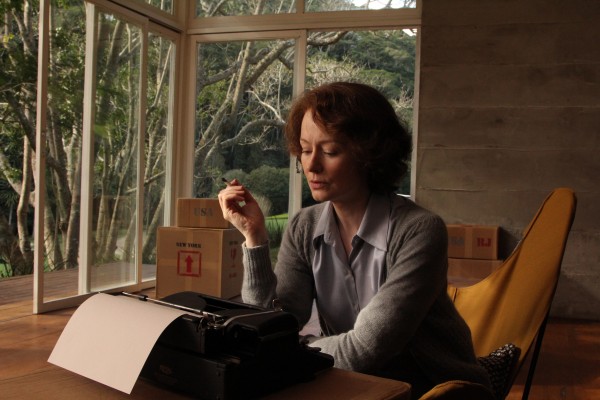
With all the recent focus on another doomed love story featuring two women titled “Blue…what’s it’s name again?,” some of the attention should be turned to “Reaching for the Moon.” Jokes aside, both are great in their own right. Directed by Brazilian director Bruno Barreto, best known to American audiences for “View from the Top” starring Gwyneth Paltrow, “Reaching for the Moon” is his latest arthouse film recounting classic American poet Elizabeth Bishop’s (Miranda Otto) troubled love affair with famed Brazilian architect Lota de Macedo (Glória Pires). Set against the gorgeous backdrop of Rio de Janeiro, Barreto captures the 50s and 60s through frame after frame of the country’s lush landscape.
Told chronologically, while leaving the exact timeframe ambiguous—we follow the tumultuous relationship between the hotheaded personalities over a span of close to two decades. Driven over the edge by egos and artistic success, the power dynamic fluctuates consistently and is what makes the couple’s tale so fascinating to watch, as attested by the director himself. I sat down with the director to talk about his newest film, as well his motivations for wanting to tell the largely unknown story.
Barreto laughs when describing the film as “almost like a self-help book.”
Back in the 90s, the director’s mother bought the rights to the book detailing the stormy coupledom, which flew under the radar at the time. After years of refusing to make the feature, followed by looking forever for the right angle once he agreed, Barreto finally found it. According to him, “Reaching for the Moon” is a love story about loss, rather than a biopic about the Pulitzer Prize winning poet.
Speaking on the universal appeal of the film, Barreto said: “I think the central theme of loss is something that doesn’t matter if you’re five or 50, you can relate to it. And it’s a beautiful love story. I think that one of the hardest genres [to do] is love stories.”
In 1951, Bishop visits an old college friend in Rio de Janeiro, battling writer’s block and alcoholic demons. Full of insecurities and creative dissatisfaction, she’s set to leave and then accidentally eats a cashew fruit, nearly killing herself. The poisonous fruit sets gears in motion whereby Lota, unrestrained and the poet’s polar opposite, nurses Bishop back to health and they fall in love. The latter part has enough sway to keep Bishop there for the next 15 years. Countless emotional bombs come up along the way right up to the dramatic implosion, making you think twice about where soapy fiction gets its premises.

Faced with how to humanize a beloved American poet when revealing her deepest character flaws in dealing with those closest to her, Barreto stated “one of the biggest challenges was to make a completely unsympathetic character empathetic.”
The director summed it up as: “She’s an artist and artists are vampires.” The dislike pretty much translates into an inability to take your eyes off the character, which is how it usually goes.
“It’s so improbable that these two would have a life together because they’re so different, yet they fall in love and they have the best times of their lives,” Barreto said.
Who Should See It: If your teen angst involved some sort of readings by Sylvia Plath and/or love seeing real life complex relationships adapted to screen.
Who Shouldn’t See It: If you’re not into watching maniacal artistic personalities clash and come together, sometimes into full blown melodrama.
Review by Sandy Chung. Follow her on Twitter @sndychng.