
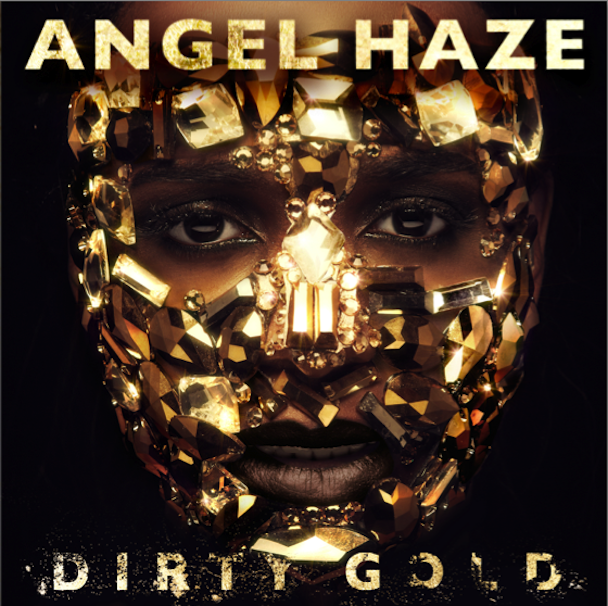

Angel Haze really wanted you to hear Dirty Gold. She even leaked it herself in order to force her label’s hand. I appreciate the bravery that it took to do that, and I also wouldn’t be surprised if it starts to happen more often. Artists are trying to take back control of their music more and more. But that’s a conversation for another day. You can call Angel Haze a rapper if you want; But Dirty Gold shows that she is much more than that. It has moments of extreme honesty and emotional depth. It sometimes feels and sounds like an electronic album more than a hip-hop album. Haze attempts to make a statement on almost every song, to varied effect. The attempt itself is valiant, and even through any slow moments or struggles, it feels uplifting. I’m not surprised that Angel Haze fought so hard for us to hear it sooner rather than later.
Dirty Gold sets up its modus operandi immediately. It’s an album that wants to be about music as a confessional; a release for both the creator and the listener. To get this point across, many of the songs start out with Haze talking about exactly what the song is about. This ends up being more distracting than anything and seems largely unneeded. She mentions that she would like the songs to speak for themselves, but it feels like she was scared to let them. It ends up only being a slight distraction, but it bores mentioning because the album does a good job of creating the narrative without any of this.
While I mentioned Dirty Gold at times doesn’t even sound like a rap album, its production still shines like one. Many of its best songs, such as “A Tribe Called Red” and “Echelon (It’s My Way)” have forceful beats that you can’t ignore. Where it gets interesting are the songs that don’t use traditional hip hop production. There are a few more pop and electronic oriented songs that play up on her style enough to keep the album fresh. On “Deep Sea Diver”, which is largely about displaced love, the electronic/dance production sets it apart from some of the other, more self-assured tracks that appear before it. This continues throughout the album, and while the second half really lacks many opportunities for crushing beats, the songs still have a strong thematic through point. It’s nice that Dirty Gold never takes this to the point where it has throwaway dance/club tracks on it, but is not afraid to change its style for the sake of the song.
Something else that I was pleasantly surprised about on Dirty Gold is Haze’s range as an artist. Her flow as a rapper is incredibly strong. She feels confident whenever she raps, and brings emotional power to many of the songs through her obvious confidence on the mic. She also isn’t afraid to sing on many of the songs, and while she maybe doesn’t have equal strength as a singer as she does a rapper, her voice is still very unique, and the way her speaking voice and singing voice play off each other is one of my favorite things on Dirty Gold.
Dirty Gold sometimes goes out of its way to make statements. Haze has songs about religion (“Black Synagogue”), suicide (“Angels and Airwaves”), and motherhood and abortion in the same song (“Black Dahlia”). These are tough subjects to make a song about regardless of what style of music you are making. The more serious songs never seem cheap or unearned, though, and credit to Haze for her honest and personal approach to each. While hip hop artists have taken on some of these subjects before, it is still surprising to hear. Haze does a pretty good job here, and when you put the album together as a whole they fit right in.
It becomes apparent by the end of Dirty Gold that this album is a therapeutic release for Haze. Everything falls into place: the speaking parts at the start of the songs feel like a group therapy session; the way it starts confident and then slowly becomes more vulnerable plays like Haze going through a mental rolodex of her insecurities, struggles, and fears. It’s as much a therapy session as it is an album. Haze highlights her struggles so the listeners can rise above theirs.
That a hip hop artist of any gender was able to release such an exposing album is commendable whether the album is good or not. And Dirty Gold is pretty good. It’s an album that feels challenging, not only for the listener, but for the artist as well. It talks about many subjects that could easily be considered depressing, but it sees how struggle can make eventual success that much more sweet and uplifting. It’s an album that wallows in its creators’ lowest points, but doesn’t dwell on them. When you finish Dirty Gold, you’ve gone through a lot, but Haze herself on the title track lets you know that throughout her struggles, she got to where she is now because of them. Good or bad, they made her who she is, and she made it through them to be the strong person she is now. Once you’ve heard Dirty Gold it’s not surprising that her label couldn’t keep it hidden away.
Review by Justin Owlett. Follow him on Twitter at @justowle.