
Review by Sasha Maese. Follow her on Twitter @Sasha_Dove.
You’ve probably walked past the James Farley Post Office a million times; it’s that enormous building on west 31st Street that looks like it may or may not be abandoned. In reality, parts of it are still a functioning post office, while others will be converted into a concourse for Amtrak. The remaining areas, including the location for Armory Week’s “Spring/Break” in Skylight at Moynihan Station, seem very much abandoned. It’s within this intriguing landscape that the show took place.
The theme for this year’s show was “Transaction,” and it’s described on the show’s website as “…visions of and commentaries on exchange in all its forms. Bodies in their exchange of gesture. Education in its exchange of ideas. Commodity in its exchange of objects.” It’s an interesting choice for a show, taking place in a location once frequently inhabited but now left empty most of the year. “Spring/Break” features an enormous amount of work that unwinds through the long corridors and interconnected offices of a building that seemingly hasn’t been renovated since the 1950s, the broken linoleum and decaying plaster continuously chewed up by decades of wear and tear.
The artists featured in “Spring/Break” rose to the challenge of staging their work in a space already teeming with so much character, their works augmented by enough natural light to incite jealousy from anyone who’s ever rented an apartment in Manhattan. Upon entering the show, one of the first collections seen is Philip Garner’s “Better Living Catalog,” organized by Sam Parker. It includes a never-before-exhibited series of sculptures, drawings, and apparel from throughout Garner’s career. Many of the pieces shown, including “Half-Suit” (for business meetings in the summer) and “Heels on Wheels” (for women running late), were created to revisit the consumerist culture associated with catalog shopping in the 1980s. According to the artist’s statement, “Each object seems to beg the question: ‘Can you believe you’ve been living your life without it?!’”
In another take on the idea of transactions, this time in the social sense, Garner also showed a series of customized statement T-shirts that seemed rooted in the early 2000s trend of wearing your opinion on your chest. Appropriately hung in one corner of the room, the shirts featured statements like “I Tested Positive for Ennui”, “What’s Your Favorite Artificial Flavor?”, and “Fun Sucks.” If you listened closely enough, you could hear the Daria theme song playing quietly in the background (well, not really — maybe just in your head).
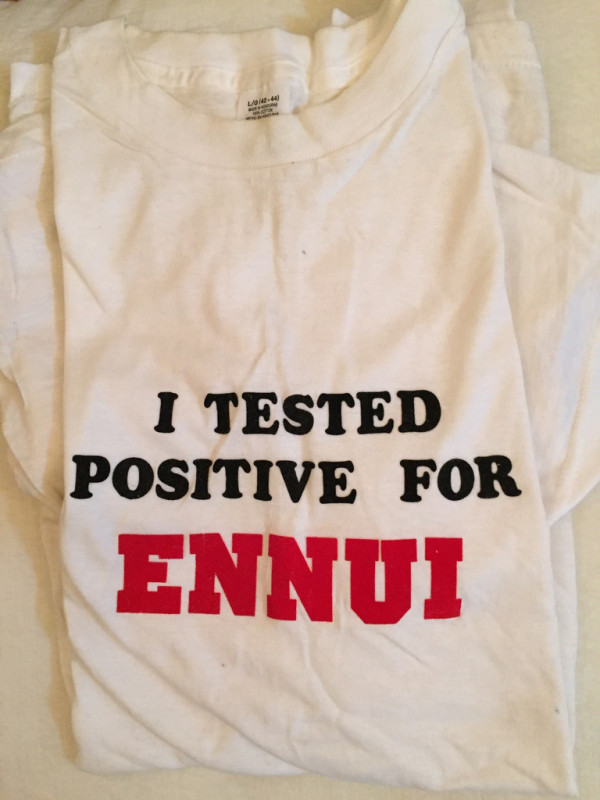
Pippa Garner, “I Tested Positive”
For artist Jo Shane, the bright sunlight of the mid-March afternoon provided a heartbreaking contrast to work reflecting 30 years spent on antidepressants. Whereas many artists were following the theme of Transactions, Shane seemed to be doing the opposite – highlighting her struggle to perform transactions that may have come so easily to her peers. In her installation “Autobiography/All Of The Psychopharmaceuticals Prescribed 1984 – 2014,” 30 years of prescription drug packaging lay on the floor in front of three bug zappers, as if she were going towards the light and was abruptly knocked out of it over and over again.
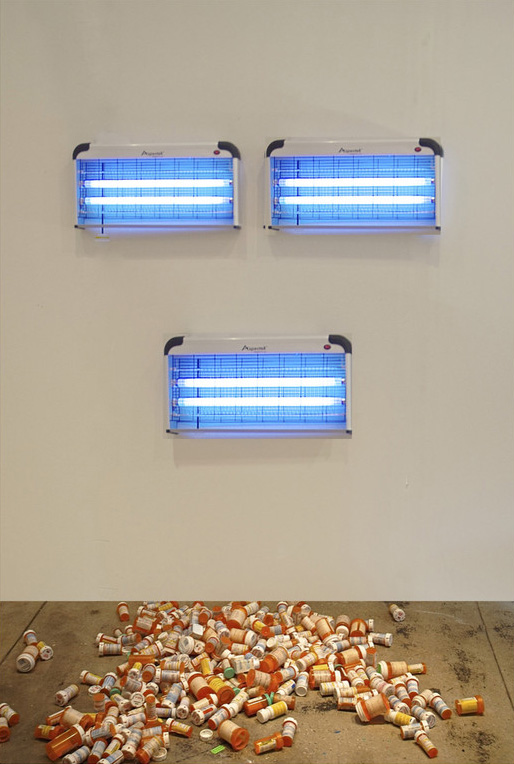
Jo Shane, “Autobiography/All Of The Psychopharmaceuticals Prescribed 1984 – 2014”
Another work Shane showed was the incredible “Cymbalta Dreams,” featuring an ice cream cone next to an official Cymbalta-branded tissue box. Cymbalta is a prescription antidepressant, and whatever advertising executive had the idea to brand tissue boxes for psychiatrists was probably super proud of themselves for thinking of it.
One of the shows that has already gotten a lot of press is Dustin Yellin and his Bazaar Teens collective’s “The Riches of God’s Love Unto the Vessels of Mercy.” The artist took a literal approach to the idea of transactions and affixed $10,000 worth of shredded money to a series of eight brown canvases. Each piece was priced at $10,000, the proceeds donated as grants to high school students interested in art.
However, the shredded money was only the beginning. After exploring a room filled with what appeared to be rudimentary children’s paintings and a coffee fountain, visitors can venture deeper into Yellin’s space, finding themselves in a narrow hallway with bread covering every surface, an installation called “Hallway of Christ.” Aside from the bread nailed to the wall, unopened loaves littered the hallway, as did pieces of bread that people tracked in and out with their shoes. In fact, everywhere you stood in Yellin’s space, you were standing in something that probably shouldn’t have been there. This opened into a wood-paneled hell that, to me, resembled the waiting room in a mechanic’s shop that time had forgotten. Whereas many artists made an effort to find the beauty in their ravaged gallery spaces, Yellin thoroughly embraced (and added to) 50+ years worth of grime.
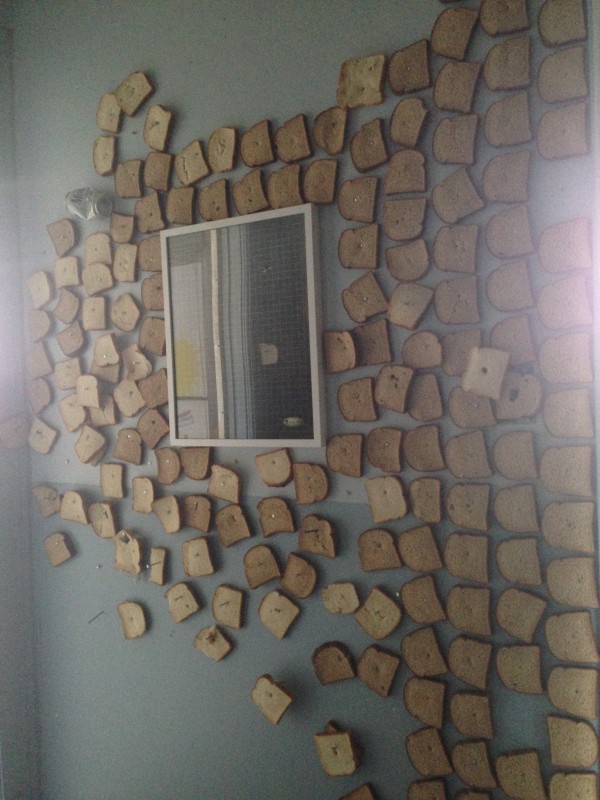
Dustin Yellin and Bazaar Teens, “Hallway of Christ”
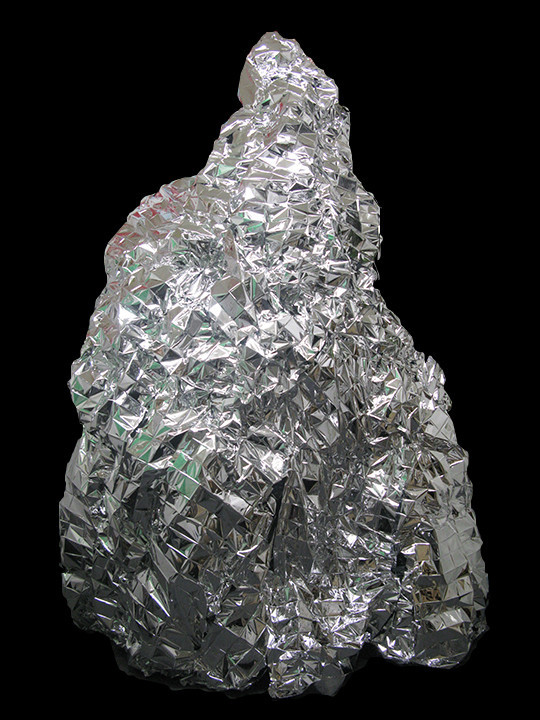
Of the artists who chose to avoid natural light, Grace Villamil’s “A Door Within a Door” inhabited the perfect space inside a disused vault. Villamil chose the vault as a symbol of keeping things of value safe, believing that “the most valuable transaction is the intimate one we have with ourselves.” Her artist statement describes the installation as “… a multi-sensory experience that combines light, sound, sculptural installation and music performance….” Large mylar rock formations invite visitors to come inside. Laying on the artificial grass placed there, gently cycling lights and a soundtrack of quiet voices reverberating against the walls of the space at different pitches make this installation my most oddly peaceful experience in a long time.
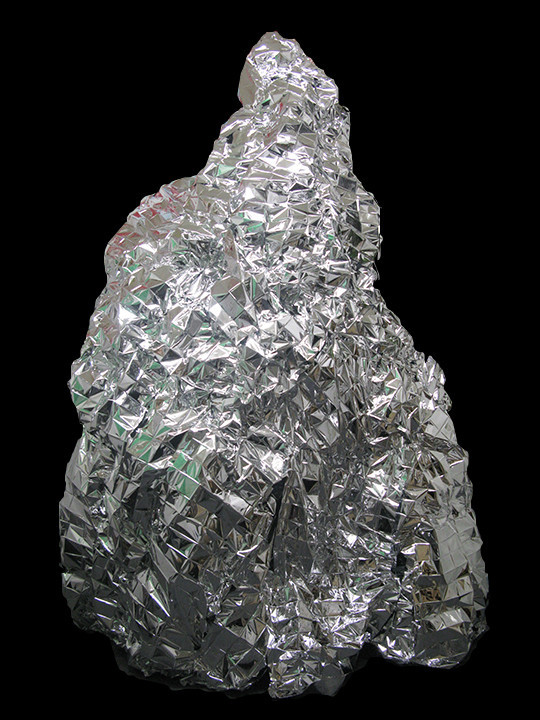
Grace Villamil, “Silo: Moynihan,” from “A Door Within a Door”
Considering the size of the space and the breadth of work involved, it’s amazing that organizers The They Co. were able to make it all work. Just viewing the exhibition took hours, and sensory overload seemed at times a credible threat. For those in New York who feel like they’ve seen everything, this was definitely something new. I’ve never been so pleased at being so disoriented.