
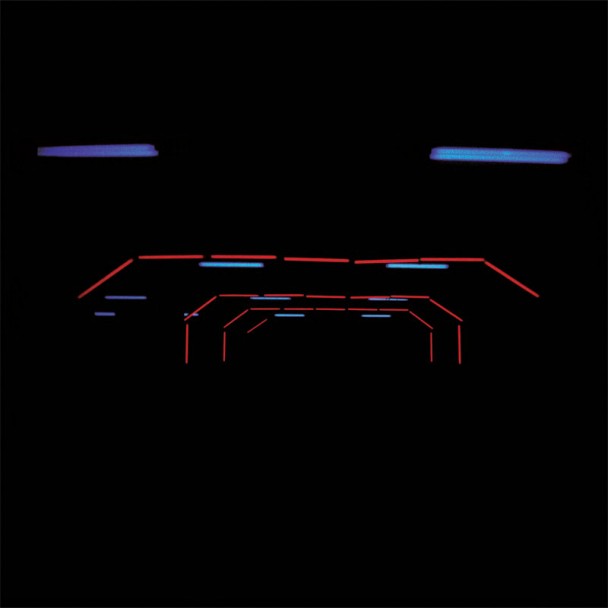

The concept of Robert Alfons, a.k.a. Trust, naming his second album Joyland is a little bizarre on first blush. His first album, TRST, almost felt like the logical end of the dark electronic genre (or witch house if you will). Alfons’ voice could have easily fit over brutal metal guitar as well as it does over a suffocating house beat. It’s possible that even Alfons’ himself saw that the style might be just a tad too dark. Where TRST felt like it was played in a windowless room with only spastic strobes as a source of light, Joyland feels like it is Alfons’ style once natural light has been cast on it. It has transcended the murky underground and landed maybe not in the sky, but at least on an open plain where the sun breathes through the clouds. This sunnier disposition manages to fit this music better than the listener could have ever expected. The description of the album on Arts & Crafts website simply states the album is “an eruption of guts, eels, and joy.” While succinct, that description does a good job of laying out exactly what makes Joyland such a wonderful sequel and companion piece to TRST. It is fortified with a brighter outlook on life, and even through the twisted style of its genre, it radiates a murky positivity that not many other albums with similar style have been able to duplicate.
The mood of Joyland is set almost immediately. The opening track, “Slightly Floating,” gives us a first taste of the album’s more ephemeral aesthetic. While it acts closer to an introduction than an actual song, it exudes a completely different feeling than what we’ve heard before from Alfons. The best way to describe it is delicate. It feels carefully crafted, and while his music has always been complex, it’s never really felt anywhere near as subtle as it feels on “Slightly Floating.” Other songs show this craftsmanship as well. The most notable on the album are “Are We Arc?” and “Joyland” itself. “Joyland” completely drops any pretense of a dark sound and utilizes upper key synth and falsetto vocals to create an almost completely new sound for Trust. It’s possibly the most obvious signifier of Alfons’ promise to make a joyful experience of Trust’s sound. “Are We Arc?” seems to mix both the previously mentioned songs, utilizing a closer ambient sound with falsetto mixed into the normal vocals. It fits more into the middle ground that much of the album inhabits, somewhere between dark and light.
That middle ground is still heavily rooted in the signature sound that Alfons has created for Trust. It’s a highly stylized form of electronic music. Sleek only begins to describe it. It bleeds neon and strobe. He has always had a knack for knowing when to drop a beat or take a complete left turn in either timing or vocals. On Joyland he’s added much more vocal pitches and distortion as well, giving his style an even more far reaching range. This allows him to almost artificially create that feeling of joy at points. It can feel a little forced into some songs, but for the most part the whole aesthetic feels risen up. TRST felt dank, and that worked for it in its own way. On Joyland, Alfons willingness to embrace a positive view could have easily been a gamble he lost, but instead it allowed him to broaden his spectrum. While it doesn’t run a full gamut of colors, it has allowed him to add more shades than just black and gray.
One concern when dealing with Trust since its inception is that Alfons’ vocal style lends itself to unintelligible lyrics. This hasn’t changed much on Joyland, though some snippets manage to make their way through clear enough. Small pieces like “You’re much too much” on “Geryon” and “I’m getting used to the loneliest of sounds” in “Are We Arc?” manage to come through clear, but for the most part it can be hard to understand what’s going on in most songs. Luckily, we have a pretty obvious mood setting both in the music and in Alfons’ vocals, so it isn’t impossible to understand what each song is trying to convey, even if it can feel vague at times.
One of the best signifiers of a good album is that it finishes as strong as it starts. It allows an album to keep the listeners attention all the way through the album instead of blowing all its best songs at the start of the album in an attempt to almost sucker someone into thinking the whole album is as good as the first few songs. Joyland starts out incredibly strong, so it was always possible that it would fizzle out by the end. Luckily this isn’t the case, as its last four songs are some of the best work on the album. It kicks off with the biting “Rescue, Mister,” which is one of the most prolific and catchy tracks Trust has put out so far. It uses distorted vocals possibly the best of any of the songs on the album, which is saying a lot. “Lost Souls/Eelings,” which we have to assume lends the “eels” part of the album’s description, is a low key (by Trust’s standard) affair that crawls on its belly throughout and may be most impressive in its ending, that cuts into an ambient haze similar to the introductory track on the album. “Peer Pressure” is a blissfully manic track which is followed up by the album closer, “Barely” which has an emotional weight rarely seen so obviously in Alfons’ work. It’s almost a shame it’s the final song on the album because it will surely get looked over. What can be taken from this is that minus a few hiccups, Joyland is one of the most complete albums released so far this year, which is remarkably impressive for what is in essence a house album.
Lyrics play a very important part in any music. If a song has them, they should be paid attention to. Joyland’s one shortfall is the muddied status of exactly what Robert Alfons is singing at any given time. That being said, he has sculpted a style that is still able to convey the mood of a song regardless of how much of the lyrics you understand. Each new song can feel ecstatic, downtrodden, manic, or even indifferent. All of this built on a house beat. It’s quite an impressive feat, and the fact that Joyland manages to keep the listeners attention throughout instead of just loading up on a few supercharged songs shows that the evolution Alfons has gone through as an artist from TRST to Joyland is remarkable. It may not have the completely slick and blotted out aesthetic that made TRST so great to listen to, but in its place is an almost more beautiful style. Joyland is a study in what happens when you take a foreboding and inherently dark genre and inject some life into it. That Alfons was able to succeed at this is worth applause, and that he was able to transform his sound from cataclysmic into upbeat and joyous is nothing short of miraculous. It’s an impressive and almost bold move that paid off not only for the artist, but for the listener as well.
Review by Justin Owlett. Follow him on Twitter @justowle.