

It was middle school, and I was fat and in and out of phases minute to minute. Vaguely punk, vaguely gothic, vaguely skater, vaguely hippie. I was dipping into everything, hoping to uncover something I could use to rally against the bullshit and angst that came with the territory. I was searching for some real, misunderstood version of me that would somehow make everything easier. So I spiked my hair and painted my nails black, wore parachute pants, scabbed my knees botching kickflips in this or that bank’s parking lot. I lived in a Jersey suburb 45 minutes south of the city and I was clawing at every chance to establish a self that was confident and different. Of course, none of the gimmicks stuck — the chain wallet and dozens of colored wristbands got the boot real fast — but through all of the pimply uncertainty and awkwardness and random, at-the-slightest-hint-of-a-breeze hard-ons, music was there, and it made sense, and it offered some comfort.
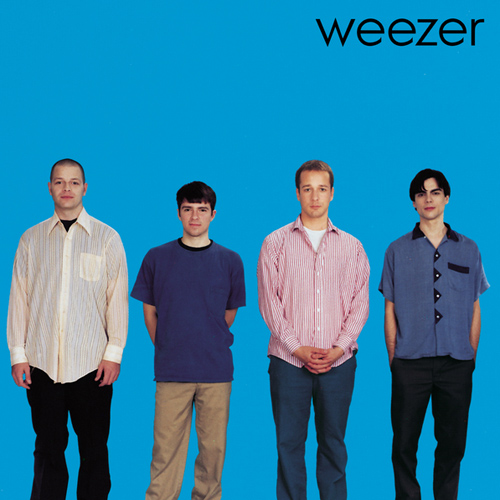
What I listened to was in flux as much as my clothes and hormones, ranging everywhere from Slipknot to Pink Floyd to Cold to the Ramones. Still, I distinctly remember the moment my friend Phil let me borrow an album that seemed to just get me and where I was and what I was going through, an album that rooted for me and all of the other unathletic nerds who spent hours playing PS2 and read Lord of the Rings beneath their desks and wanted girlfriends ever since they were in elementary school and were too damn sensitive for their own good. That album was Weezer’s 1994 self-titled debut — affectionately known as The Blue Album — and this past weekend, that collection of 10 songs celebrated its 20th anniversary. Crazy, right?
Now, Blue’s lasting success can be contributed to many factors, most of which aren’t predicated on anyone’s nostalgia today. Sure, my memories of the record are based in a very specific and distant time, location, and mindset, but when taken at face value, each of these 10 tracks feel as fresh and earnest as they did in ’94. When I listen to Blue, I don’t think, “Well, that’s some good ‘90s alt rock right there.” It’s more visceral than that, timeless. The punk-influenced distortion, the poppy melodies and hooks, the reinvigorated love for guitar solos, the tender vulnerability of Rivers Cuomo’s lyrics. It was a bona fide style, one that was so unique and far removed from the then in vogue grunge scene that it’s no surprise Blue caught everyone’s attention. And, as time has shown, for good reason, too.
“My Name is Jonas” jumpstarts the classic release with a swift acoustic guitar riff that eventually bleeds into a familiar rock / punk chord progression. It’s catchy and explosive, centered around a waltz-like tempo, and when Cuomo sings “Thanks for all you’ve shown us / But this is how we feel,” you know everything that follows is going to be innovative, honest, and raw. Enter the dichotomy between the poppy paranoia of “No One Else” and the grinding desperation of “The World Has Turned And Left Me Here.” One second Cuomo is boasting how his girl “puts her make up on the shelf” and “never leaves house,” and the next he is “[making] love with [her] sweet memory” and “[talking] for hours to [her] wallet photograph.”
Like the two sides of this particular story, the album’s narrative escapades are almost always at the forefront of each song, influencing — though not necessarily dominating — Blue’s sonic tones and moods. Where Weezer thrives, however, is in their ability to craft songs that refuse to pigeonhole themselves within the expected parameters of certain attitudes, and, instead, simultaneously invite you to sit back and reflect and sing along and bounce around. The singles are notorious for this.
“Buddy Holly” may, at a glance, seem like a campy carefree time, but it’s also a polite fuck you to the haters (see lyrics: “I don’t care what they say us about anyway / I don’t care about that”). And while there may be really stoked bros, fraying sweaters, and Superman undies thick in the mix of “Undone — The Sweater Song,” the core of the song is actually comprised of anxiety, dejection, and the fear of being exposed — just look at the virtually nonsensical verses, which suggest a profound sense of paralysis follows after revealing too much of yourself. “Say It Ain’t So,” on the other hand, tries to play it cool but inevitably shatters the illusion in a gruff, emotional chorus, with Cuomo pleading, “Say it ain’t so / Your drug is a heart breaker / Say it ain’t so / My love is a life taker.”
In an interesting reversal of this multifaceted emotional outpouring, tracks like “Surf Wax America,” “In the Garage,” and “Holiday” seem to encourage solace through escapism, whether by spending a day at the beach, playing guitar and Dungeons and Dragons in the garage, or setting off in search of some idyllic wonderland far, far away. The prime example of this — as well as the inarguable opus of the record — is the eight minute giant and closer “Only In Dreams.” Easily my first “favorite song,” “Only In Dreams” is a musical and lyrical roller coaster filled with melancholy, pining, and hopeful possibility. The tender track opens with a simple but unforgettable bass line, followed by a slow layering of drums, acoustic and electric guitar, and finally vocals. “You can’t resist her / She’s in your bones, / She is your marrow / And your ride home” Cuomo sings, opening the track with the sort of mythologizing that happens when you’re first falling in love. The song itself follows suit, becoming its own mythology as guitar lines intertwine in a dynamic call and response, with bass and drums propelling the tempo and tension forward, resulting in a tremendous and unforgettable climax.
Sadly, Weezer hasn’t been able to replicate the immensity of “Only In Dreams,” or Blue for that matter (truth be told I probably enjoy Pinkerton more, but that release is a categorically different feat). But as I’ve gotten older, I’ve come to care much less whether or not they make anything as monumental — because they had Blue, and having one Blue is more than most band’s ever get. Blue transformed alt rock (and probably all of rock), and while they might have been able to anticipate some initial commercial success, I doubt Weezer or anyone else could have imagined how instrumental this one album would be in helping pave the way for an entirely new genre of music and, consequently, countless imitators. So this is thanks for the tunes, fellas, and for being there when you were needed most.
Review by Justin Davis. Give him a hi-five @yeahjustindavis.