

*Spoilers below*
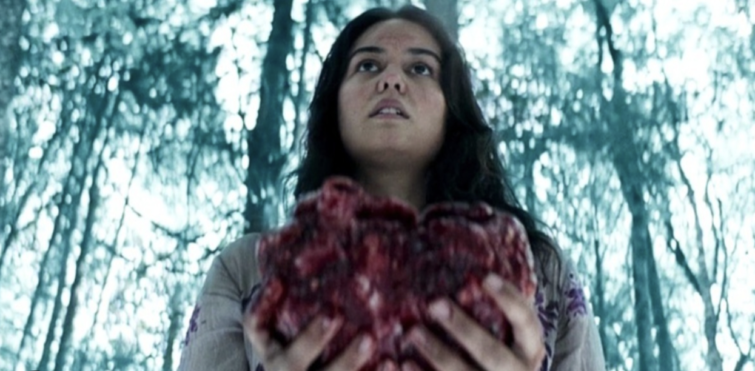
The most romantic, tragic, and bone-chilling moment in Showtime’s Yellowjackets, occurs in the second episode of the second season. The doomed New Jersey soccer team holds a vigil for their captain, friend, and (pardon the pun) queen bee, Jackie. Jackie has frozen to death overnight and now they are about to cremate her. Jackie’s best friend Shauna, tearfully says, “I don’t know where you end and I begin.” This is after Shauna has spent the last week speaking to Jackie’s corpse, applying makeup to her dead face, and eating her friend’s ear. The first act of cannibalism performed by the soccer team is not an act of desperation, nor one of debauchery. It is an act of grief and complicated love that reads on screen as a consolation of a longtime pining that has driven these two women to the ultimate act of intimacy: to consume each other so that they will never be parted, either in this life or the next.
Cannibalism has been tied with carnal and romantic desire since it first cropped up in literature. If you listen to the late film critic Roger Ebert, the vampire is just a cannibal with good table manners, and the first instance of the vampire is Sheridan Le Fanu’s Carmilla. Carmilla is a female vampire who befriends and falls in love with the human girl, Laura, and the two become co-dependently entwined in their desire to never be parted from each other. Carmilla feeds on Laura in her sleep, while Laura has increasingly pleasurable dreams that muddy the line between pain and ecstasy. Eventually, it is revealed that Carmilla had hoped that by feeding on Laura, she could transform Laura into a vampire as well so that the two could keep their love forever.
Cannibalism has its romantic basis in the desire to keep a piece of your love with you even after they are gone. Eating is an intimate act. To share food, with someone else, to engage in a physical behavior of consumption is to open yourself up to other animal desires. To open your mouth wide, to swallow, to salivate, each action is both sensually carnal as well as strikingly mundane in the reality of chewing and swallowing. Cooking for someone else, providing them food, nourishing their body, these are all common in modern dating. Of course, the taboo version of this would be nourishing them from your body.
Of course, even when the sexual components of cannibalism aren’t stated outright, they usually exist in subtext. In Antonia Bird’s Ravenous, the cannibal characters are both male. Cannibalism in this context is a form of taking power from a rival, becoming strong and dangerous. However, this power struggle takes the form of a satanic temptation of an angelic young man by another man who first appears nude and covered in blood. The latter character describes the act of cannibalism as a wanton act that allows him to become more virile. He literally says this. I’m going to go out on a limb here and say that this queer subtext borders on overt.
Female sexuality is already a taboo subject even as a natural impulse. It is treated as monstrous if a woman is openly sexual. She becomes a temptress, a witch, a femme fatale. She tempts men into horrible acts that go against their morals. Cannibals, succubi, and vampires are just the reality of female sexuality taken to its most horrifying, but seemingly obvious, conclusion.
Movies like Raw and Jennifer’s Body position cannibalism as a gateway to female hypersexuality, which inevitably positions men as prey. The myth of heterosexual sexuality is that when a man sleeps with a woman, he is the aggressor, taking something from his vulnerable partner. The female cannibal turns the relationship on its head, positioning the woman as predator and the man as prey, as literal food. In this relationship, it is the woman taking from the man, sometimes taking so much that the man will not be able to survive it. However when the cannibal woman is matched with another woman, only then are they shown and show compassion in turn. In this parable, queerness also means safety. Even when they kill the other woman (or in Ravenous the other man), it is a show of mercy and of love, not of a simple meal.
When Needy kills Jennifer it is an act of compassion, she finally understands Jennifer and what drives her. She also takes within her Jennifer’s spirit, her power, and her confidence, becoming a stronger character, in complete control of her own sexuality. In Raw, Justine kills and eats her sister, at her sister’s request. Her sister has been a more confident, more imposing version of Justine throughout this film, pushing her to be more outspoken and sociable. Justine has rejected this advice, fighting against it as much as she can up until a hazing ritual which sets off the sequence of events leading Justine to her cannibalistic tendencies. Her sister is also a cannibal as it turns out, and she wants to pass on the torch to her younger sister.
In both of these films, the consumption of another woman is an act of grace whereas the consumption of a man is just dinner. Similarly in Ravenous, the connection between John Boyd and Col. Ives, the two main cannibals of the film is more important than the connection each of them has with their meals, even though Ives ends up at the end of Boyd’s teeth at the end. They understand their fellow cannibal as an equal and often know who and what they are at first sight even without it being explicitly shown. Bones and All alludes to this kind of recognition of community where the young cannibal Maren finds companionship with other outcasts, alluding once more to the queer experience.
Bringing it back to Yellowjackets, though Shauna has a sexual relationship with Jackie’s boyfriend, it’s really Jackie herself who Shauna covets. Jackie haunts Shauna after her death, telling Shauna that she only slept with Jackie’s boyfriend so that she could pretend to be Jackie. After this scene, you remember that this is Shauna imagining Jackie saying this to her. Shauna might want to be with this boy, but she wants to be Jackie. And what better way than to consume her and her power? So Shauna, having created this elevated connection with Jackie following Jackie’s death, emerges from her slumber, finding Jackie’s corpse roasted in the failed cremation that they had attempted earlier. Shauna says that Jackie wants them to do this. Because Shauna has this intimacy with Jackie already. She already has a deeper connection than the rest of the team does, having already consumed Jackie’s ear. These women all agree to this bacchanal of consumption, a Dionysian ode to life and love for their lost captain. Only their adult male coach, Ben, doesn’t understand their behavior. Because he is not one of them. He is an outsider to the cannibal world of these women.
Cannibalism in its most distilled essence, represents a frightening sexuality. A woman who is the aggressor, who takes joy in sensuality and indulges that enjoyment without censorship. A queer relationship that is overtly sexual and takes precedence over the heterosexual relationships on screen or on the page. Really, cannibal stories are always deconstructions of the taboo, from the perspective of those who are seen as monstrous for indulging in these taboos. In Yellowjackets, the soccer team has one choice to make: eat or die. The choice is obvious. Hunger demands to be fed, it doesn’t matter how monstrous it might seem to an outsider looking in.